
Your Money-Strong Dashboard: How to Track Progress Without Obsessing
Key Takeaways
You don’t need to obsess over complicated details to track your financial progress.
The Money-Strong Dashboard is a simple, motivating snapshot of your most important numbers for my financial coaching clients.
When you keep track of your key numbers, you see your big-picture progress.
Do you know your total household income? Do you know your net worth?
If the thought of monitoring your money leaves you overwhelmed, you’re not alone.
Maybe you’ve tried budgeting apps that show you graphs you don’t understand, or spreadsheets that take hours to maintain.
Or maybe you’ve avoided tracking anything altogether, because you’re afraid of what you’ll find.
Here’s the truth: you don’t need to obsess over complicated details to track your financial progress.
What you need is a simple, motivating snapshot of your most important numbers.
For this purpose, I created the Money-Strong Dashboard for my financial coaching clients.
Why Tracking Matters
When it comes to our money, we should measure what matters.
Monitoring your progress…
shows whether you’re moving in a healthy direction over time.
helps you stay motivated by celebrating wins.
provides objectivity amidst volatile feelings.
prevents disengagement from your financial health.
Without tracking your finances, it’s easy to feel stuck or assume nothing’s changing. A more objective look might reveal more to celebrate than you realize.
I can’t tell you how many times I’ve sat down with a nervous client to show them numbers on their Money-Strong Dashboard that made them smile.

Or perhaps you like to downplay problems. Maybe you tell yourself, “It’ll all work out,” because you don’t want to take a clear look. Keeping track will snap you back to reality, alerting you to weak areas.
When you keep track of your key numbers, you see your big-picture progress, even when it’s not obvious otherwise.
When Tracking Backfires
But not all forms of tracking are helpful.
If you’re logging in to your accounts every day for no apparent reason, you risk feeding anxiety instead of building confidence.
I worked with a client who opened his checking account app several times a day just to “make sure everything looks ok.”
He saw where the balance stood. He saw that no fraudulent charges had been made.
Yet it didn’t alleviate his urge to repeat the routine a few hours later.
The problem wasn’t that he was looking at his account so frequently. The problem was that doing so never showed him what he was looking for—and it was never going to.

His healthy concern had him longing to know, “How am I doing with money?”
But no one can see their financial health just by looking at their checking account.
When he looked at his Money-Strong Dashboard, he finally saw the numbers that answered his underlying question: Am I doing alright?
Thankfully, the Dashboard showed him that, yes, he was on the right track in most ways! He immediately noticed a couple areas of neglect where he could take action.
He could let go of the habit of opening his checking account details throughout the day. He felt happy to graduate to a more advanced and effective monitoring habit.

The truth is, if the way you watch your money feels like a compulsion, and it fails to tell you whether you’re doing alright financially, it’s not a trait of financial strength.
It may even be a symptom of a problem—an inadequate sense of your overall financial health.
In a season of crisis, like when you’re temporarily without income, obsessing over micro-movements might be necessary.
But it’s not a promising habit long-term. There’s so much more to your financial life than a checking account. What matters is the bigger picture.
The Money-Strong Dashboard
I designed the Money-Strong Dashboard, a spreadsheet that highlights your most important numbers, to give my clients a clear look at their money situation.
With clients who want to work together beyond a free intro call, I like to sit down for a one-time, 2.5-hour Groundwork session.
Our Groundwork session is all about getting clear on the present state of your money life.
With money, everything is connected to everything. In order to see the best path forward, you want to see as much of the picture as you can.
Everyone deserves a good sit-down like this, at least once in their adult life.
If you’ve made an effort to get out of debt, build up savings, or spend less, and you hit a wall, it may well be because you weren’t starting with a clear view of your whole financial life.
Before our Groundwork session, you answer a questionnaire. I use those answers to put together your personalized Money-Strong Dashboard. In your Groundwork session, I share your Money-Strong Dashboard for the first time.
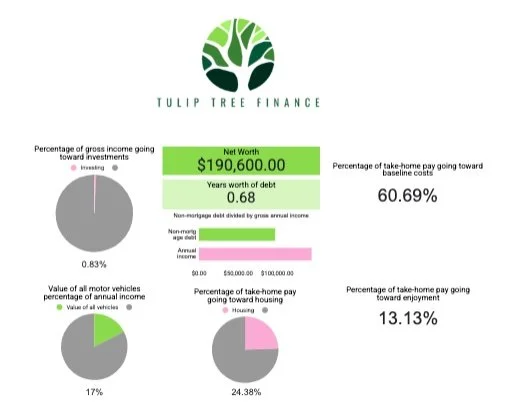
Think of your Money-Strong Dashboard like the results of an annual health checkup.
A checkup doesn’t look at every bite you eat or every step you take. Instead, it gives you a snapshot of overall health by looking at key numbers: heart rate, blood pressure, etc.
Your Money-Strong Dashboard works the same way. It reflects reality from the time you answered the questions.
Over time, your numbers will shift and evolve. Clients duplicate the Money-Strong Dashboard from one month and create an updated version. This is how they compare where they were 2 years or 6 months ago to where they are today.
What Your Dashboard Shows
In one glance, your Money-Strong Dashboard shows key measures of financial health, like:
Net Worth: How rich are you?
Savings Rate: What percentage of your income gets set aside for future use?
Debt Burden: How much total non-mortgage debt do you have, compared to your income?
Emergency Fund Level: How many months of expenses could your savings cover?
Investments: How much of your income gets invested for the long term?
The Bottom Line
Tracking your money shouldn’t keep you glued to an app or a confusing spreadsheet. And it shouldn’t leave you unclear about how you’re really doing with money.
With your Money-Strong Dashboard, you get a clear, motivating snapshot of your financial health.
Building financial strength isn’t about anxiously peeking at your checking account every day. It’s about knowing, strengthening, and celebrating your long-term trajectory.
