
50% Off Is Still 50% On: The Mindset Shift That Saves You Thousands
Key Takeaways
Recognizing the difference between saving and spending—can save you thousands over time.
Every dollar you spend on one thing is a dollar you can’t spend—or save—elsewhere.
The key is being conscious of how your feelings affect you in the store so you can make decisions with your eyes wide open.
Picture this: you’re at the store and see a sign: 50% OFF TODAY ONLY. Your heart beats a little faster. It feels like you’ve stumbled onto a win.
You grab the item, swipe your card, and tell yourself, “I saved $200!”
But here’s the truth: you didn’t save $200—you spent $200.
50% off is still 50% on. And if you didn’t need the item in the first place, you didn’t save anything at all.
This mindset shift—recognizing the difference between saving and spending—can save you thousands over time.

If you buy more, you save more. And haven't you been saying you want to save more?
Why Discounts Are So Tempting
Marketers know exactly how to get us excited about spending.
Sales use:
Scarcity (“while supplies last”).
Urgency (“one week only!”).
Fear of missing out (“once it’s gone, it’s gone!”).
Our brains see the red tags and percentage signs as wins, even when we weren’t planning to buy anything.
At Aldi, the “Aldi Finds” section taunts you with “Here Today – Gone Tomorrow.”

You make the smart choice to shop at Aldi. Then they exploit your FOMO.
T.J. Maxx embraces scarcity as it markets the thrill of the hunt. Consumers feel compelled to visit often since inventory comes and goes unpredictably.
That’s why it feels so satisfying to walk out of a store with a bag of “bargains.” It’s not logic—it’s psychology.
But here’s the catch: if you spend $200 on something you didn’t need, it doesn’t matter that it used to be $400. You’re still down $200.
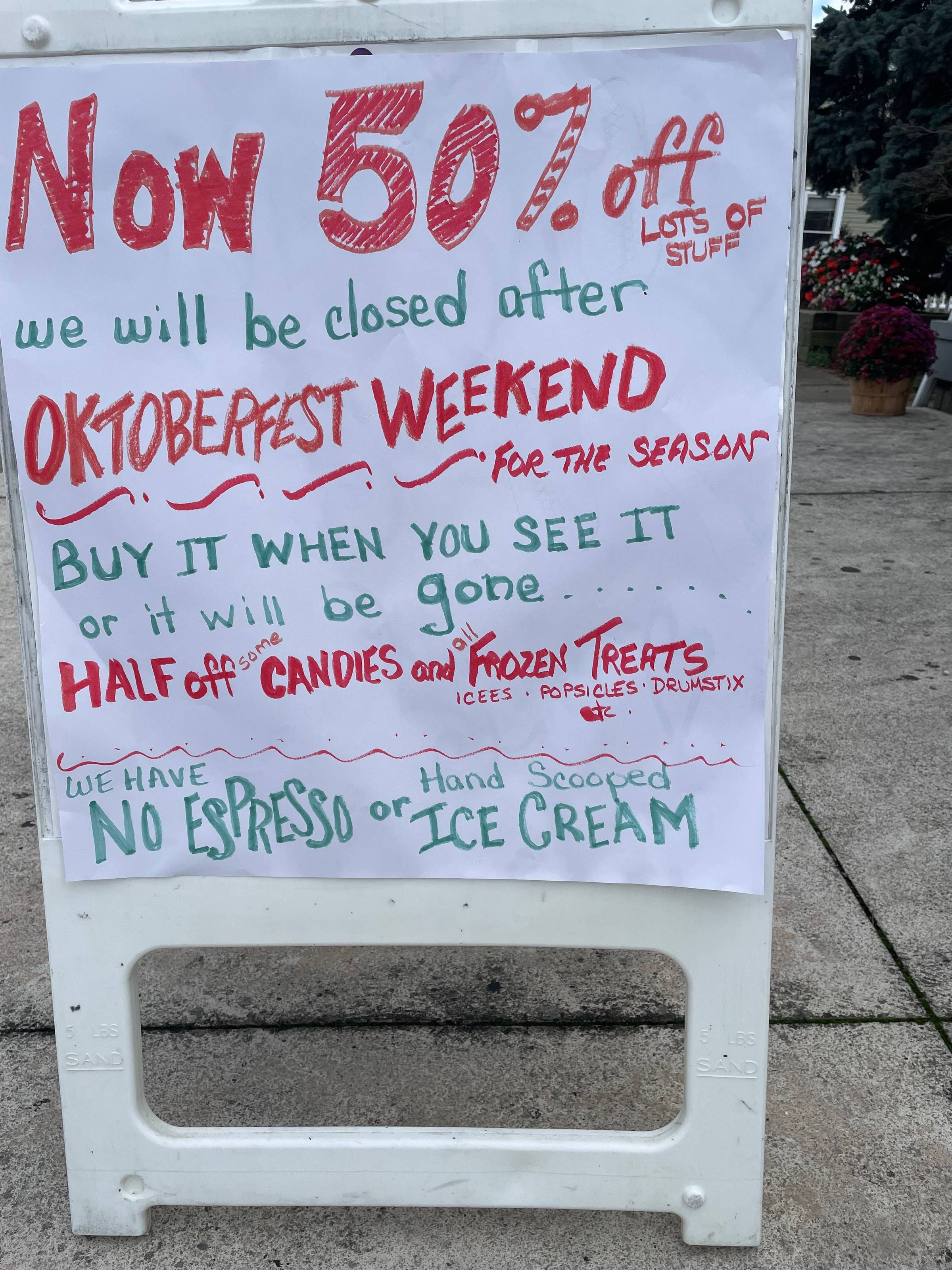
Head to Put-in-Bay to "buy it when you see it or it will be gone."
The Hidden Cost of “Saving” Money
We often justify purchases with phrases like:
“It was on sale.”
“I couldn’t pass up the deal.”
“I saved so much.”
“People spend a lot more on these than I did.”
But in reality, when you spend money, you’re not saving—you’re spending.
In an episode of “Money for Couples,” guest Christine reasons that an NFL Sunday Ticket subscription “Actually saves us money by [her partner] not going out to watch the game with friends.” Meanwhile, their household has no savings and a negative $199,000 net worth.
Imagine you buy a rug for $200 because it’s “half off.” You convince yourself you “saved” $200. But here’s what really happened:
You’re $200 poorer.
Your closet is fuller (with rugs purchased in a similar rush of excitement).
Your financial goals are no closer.
Now imagine redirecting that $200 “savings” into your emergency fund or debt payment. That’s when it becomes true savings.
The Real Mindset Shift
The key is changing the question you ask yourself. Don’t just look at the price tag.
Instead of:
“Is the price for this item relatively low?”
Ask:
“Do I need this?”
“If this were full price, would I still want it?”
“What else could this money do for me?”
This is called tradeoff thinking. Every dollar you spend on one thing is a dollar you can’t spend—or save—elsewhere.
When you reframe discounts this way, you stop chasing spending opportunities and start making thoughtful priority decisions.
Practical Tools to Resist the Sale Trap
Here are some strategies to help you avoid overspending in the name of “saving”:
Pause before purchasing. Give yourself 24 hours before buying something with an enticing price tag. Does the purchase still appeal to you after the initial excitement fades?
Check alignment. Ask yourself if this purchase supports your values and goals. Will it make your life better, or is it just an impulse? Is there another financial goal that should take priority right now? Will this purchase benefit you more than it holds you back?
Calculate the true cost. Consider taxes, maintenance, time, and space. How will you clean it? When will you install it? That $200 item might cost more than money.
Ask the full-price question. Would you still want it if it weren’t on sale? If the answer is no, skip it.
Redirect the “savings.” If you walk away from a $200 purchase, transfer $200 into savings or debt payoff. That way, you truly saved, rather than spent, the money. That’s an exciting win, too!
These small shifts add up to big wins over time.
Real-life Balance
This week, my mind and finances have been focused on an unplanned bathroom renovation.
In Lowes, Home Depot, Dollar Tree, Marshall’s, Costco, and Aldi, I kept grabbing items, filling my arms, then putting stuff back on the shelves.
I reflected on why. Amidst all the construction-related uncertainty (our home’s only shower is missing), I just didn’t want to leave the store empty-handed.
Instead of telling myself, “That’s frivolous,” I decided, “That’s fair.” So I bought myself some Junior Mints at Dollar Tree. To other random, unnecessary items, I said, “Thanks, but I know where to find you if I need you.”

When your bathroom looks like this, you deserve a checkout aisle treat.
Even when you recognize psychology at work, remember the answer isn’t always “Don’t spend!” The “Spending is bad!” money mantra does as much damage to your relationship with money as overspending. The key is being conscious of how your feelings affect you in the store so you can make decisions with your eyes wide open.
Real Life Change
One of my clients took pride in finding deals. Consuming and accumulating was framed as a “hobby” where he “came out on top” to “cheat the system.”
But after so much “saving,” he had nothing in an actual savings account. The credit card balance was growing, not shrinking.
We worked together on reframing spending. In our time together, he grew his knowledge of financial wins to achieve beyond shopping. He began transferring his “savings” into a separate, high-interest account. Money moves began to feel empowered. “Saving” became more than just not spending– it became proactive and exciting– a new skill to feel proud of.
In 6 months, he had stashed $10,000 in a savings account.
That’s the power of shifting from “I saved money by buying,” or even “I saved money by not buying,” to “I saved money by saving.”
The Bottom Line
Good deals aren’t evil. Sometimes you should grab something on sale because it improves your life.
But sometimes discounts tempt us into spending money we wouldn’t have spent otherwise.
Remember my money mantra: 50% off is still 50% on.
If you want to save thousands over your lifetime, stop asking how much you’re “saving” at checkout—and start asking what your money could do for your future.
