
Pay Down Your Mortgage or Invest? The Tradeoff Worth Understanding
Key Takeaways
A mortgage is often the largest debt a person carries.
Paying off a mortgage creates lower monthly expenses and a kind of financial flexibility that’s hard to replicate.
Historically, long-term investing in diversified portfolios has produced returns that exceed typical mortgage interest rates.
Delaying investment contributions, even by a few years, can significantly impact long-term outcomes.
Reasonable people choose different paths and still end up in strong financial positions.
You’ve built stability. You’re covering your expenses. You’re contributing for retirement. You’ve even knocked out your high-interest debt.
When you make it to this point, you’re not just solving problems anymore. You think proactively.
You have a different kind of question:
What should you do with the extra money?
Do you send it toward your mortgage—chipping away at a decades-long obligation? Or do you invest it, putting your money to work for future growth?
This is one of those personal finance debates that never subsides. Like most debates that stick around this long, it persists because both sides make compelling points.
The case for paying down your mortgage
Let’s start with the appeal of paying down your mortgage.
On paper, it’s straightforward: extra payments reduce your principal, which reduces the total interest you’ll pay over the life of the loan. Depending on your rate and timing, that can mean tens of thousands of dollars saved.
But if this were purely a math problem, the debate wouldn’t exist. The real appeal is even deeper than that.
A mortgage is often the largest debt a person carries. It’s tied to your home—and therefore your sense of stability, your daily life, your long-term plans. Reducing that obligation creates a visceral feeling of progress and control.
And eventually, it leads to a milestone many homeowners find deeply meaningful: owning your home outright.
You create lower monthly expenses and a kind of financial flexibility that’s hard to replicate.
There’s also a psychological return that doesn’t show up in spreadsheets. Less debt can mean less stress. Fewer obligations can mean more freedom.
For many people, that’s worth prioritizing.
Author Andy Hill dedicated a whole chapter to the subject, “Live Mortgage Free,” in his new book, Own Your Time.
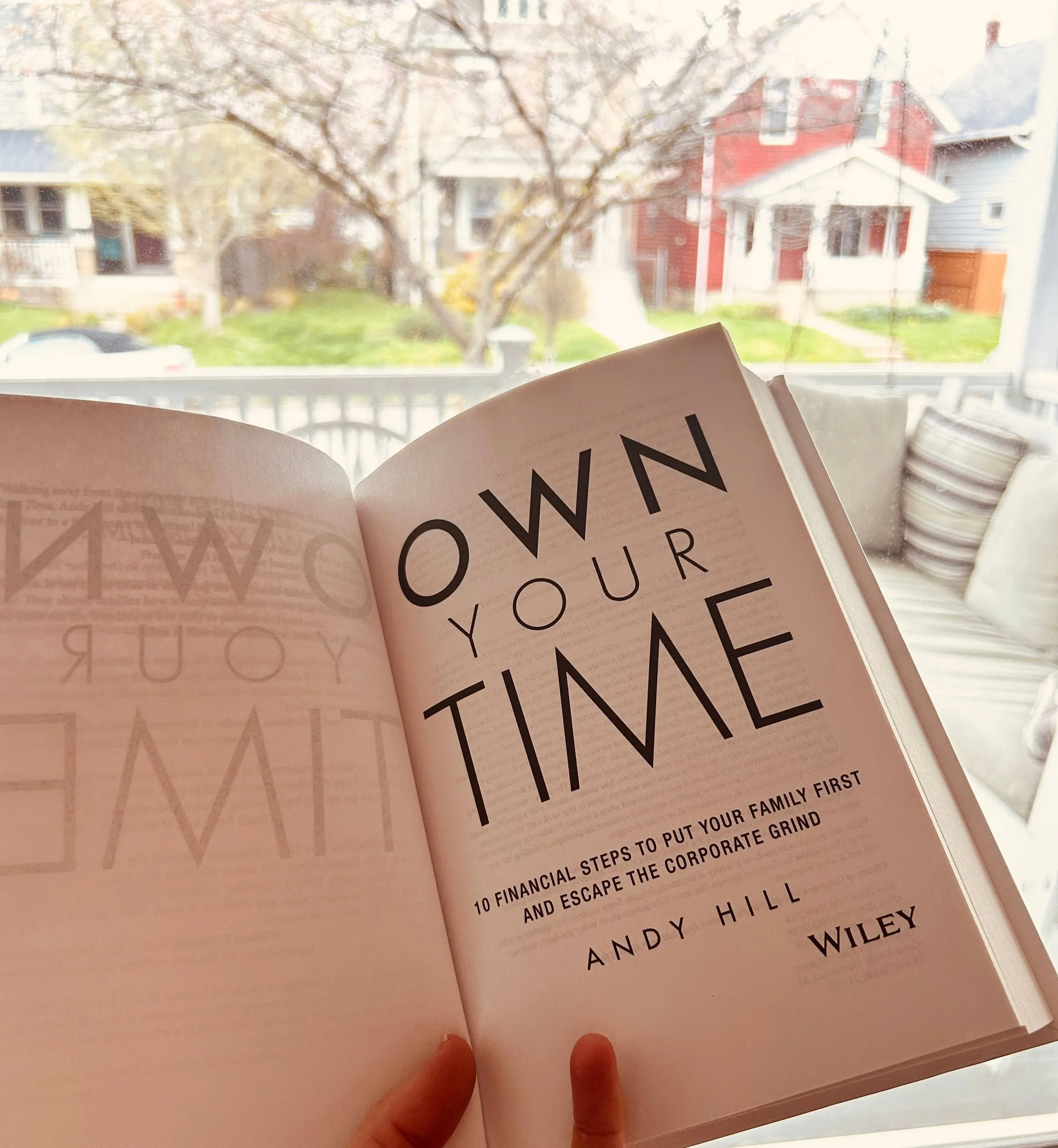
“Unfortunately, without the proper financial preparation and planning, homeownership can go from a dream to a nightmare…
Underestimating the true cost of homeownership was a huge mistake… My home owned me instead of the other way around.
When I got my second opportunity with homeownership with my wife, I vowed to do it differently…
When we found the house we wanted, we agreed that we would buy it as long as we could pay off the mortgage in 5 years, not 30 years. Having a home mortgage for 30 years when I already didn’t like my job was not something I was willing to do…
We wanted financial independence for our family much sooner than that.”
Andy Hill, Own Your Time (pages 134-135)
The case for investing instead
On the other side is the argument for investing.
Historically, long-term investing in diversified portfolios has produced returns that exceed typical mortgage interest rates—especially for those with lower fixed rates secured in recent years.
If your mortgage rate is, for example, 3–5%, and your long-term expected investment return is higher, the math suggests that investing could leave you better off over time.
There’s also the power of compounding.
Money invested earlier has more time to grow. Delaying those contributions, even by a few years, can significantly impact long-term outcomes. This is relevant for retirement savings, where time in the market matters more than timing the market.
From a purely numerical perspective, investing often wins.
But again, this isn’t just a math problem.
Investing requires tolerance for uncertainty. Markets fluctuate. Returns aren’t guaranteed. The path upward is rarely smooth.
So while the expected outcome may be favorable, the experience along the way can be uncomfortable.
What the debate gets wrong
Most versions of this debate reduce the decision to a simple comparison:
Mortgage rate vs. expected investment return.
If the expected return is higher, invest. If not, pay down the mortgage.
But this framing misses several important realities.
Expected returns are not guaranteed. Projections come from historical data, not promises about the future.
Also, personal finances aren’t optimized in a vacuum. Your comfort with risk, your income stability, your stage of life, and your goals all influence what’s appropriate.
The decision doesn’t have to be all-or-nothing.
In reality, there are successful financial plans that incorporate both approaches.
There’s room for both
In practice, people blend these strategies all the time.
You might prioritize investing during your peak earning years, taking advantage of compounding, while making occasional extra mortgage payments along the way.
Or you might focus on investing early, then shift toward aggressively paying down your mortgage as retirement approaches and your desire for stability increases.
How to think about the decision
The problem is when you do either, both, or neither option without an informed awareness of your entire financial picture.
I worked with a couple who was paying a few hundred extra toward a 3% mortgage each month while carrying a balance on high-interest credit cards and taking out student loans.
I talked them through the tradeoffs.
Making early payments toward a low-interest mortgage shouldn’t take priority when other areas of your financial health aren’t yet at full strength.
They said, “That makes sense! I never thought of that!” They paid off the cards quickly, stopped overpaying the mortgage, and focused on building savings and investments.
If your priority is maximizing long-term wealth and you’re comfortable with market fluctuations, investing more heavily may align with your goals.
If your priority is reducing fixed expenses, increasing financial security, or achieving peace of mind, paying down your mortgage may feel more compelling.
If you value both, a blended approach might make the most sense.
There’s also a sequencing element to consider.
Early in your financial journey, when time is on your side, investing can be especially powerful. Later on, as you approach retirement, reducing debt can provide stability and lower your required income.
Your strategy can evolve over time.
Andy Hill suggests that families aim to reach an important benchmark, Coast FIRE, before paying off their mortgage aggressively.
Coast FIRE is when you’ve saved and invested enough to coast to retirement without making any further contributions.
“There are so many opinions on whether you should pay off your mortgage early…
I believe this conversation of “right and wrong” can be squashed after families achieve Coast FIRE…
You’ve secured your retirement future. Now it’s time to focus on enjoying more of today.
That’s why I’m such a big advocate for paying off your mortgage early, but only after you hit Coast FIRE.”
Andy Hill, Own Your Time (page 139)
What actually matters
The biggest risk in this debate isn’t choosing the “wrong” option.
It’s doing neither.
It’s letting extra cash accumulate in a checking account while you analyze scenarios, compare projections, and wait for certainty that never comes.
Inaction has a cost, too.
Choose a direction. Don’t base your choice on mere emotion or lack of awareness.
Create an informed, proactive plan. Don’t prioritize mortgage payoff to the neglect of investing and saving.
The Bottom Line
This is one of those decisions where reasonable people can—and do—choose different paths and still end up in strong financial positions.
You don’t need to win the argument. You don’t need to defend your choice to anyone else.
But you do need a plan that makes the most sense to you—and strengthens what matters most in your life.
