
Every Dollar Gets a Job: The Simple Rule That Transforms Spending
Key Takeaways
Your money will wander off aimlessly if you don’t give it clear instructions.
Most people don’t have a system for directing their money.
When every dollar is given a “job”, you’re no longer wondering where your money went, you’re telling it where to go.
Budgets aren’t written in stone. Flexibility keeps the system sustainable.
Imagine if your money worked as hard for you as you work to earn it.
For many people, the reality is the opposite. Paychecks come in, bills get paid, and the rest seems to disappear. By the end of the month, you’re left wondering: Where did it all go?
Here’s the truth: your money will wander off aimlessly if you don’t give it clear instructions.
The antidote is simple—but life-changing: give every dollar a job.
This one rule can transform the way you spend, save, and even how you feel about money.
People Don’t Know Where Their Money Goes
If you’ve ever felt like your money “just disappears,” you’re not alone.
It’s not about intelligence. It’s about intention. Most people don’t have a system for directing their money. They react to expenses instead of leading with a plan.
Without direction, dollars slip away toward impulse purchases, forgotten subscriptions, and fluke expenses that add up fast.
The “Every Dollar Gets a Job” Mindset
Here’s where the mantra comes in: “I give every dollar a job.”
Instead of just spending reactively, as opportunities arise, this framework starts by looking proactively at all of your take-home pay.
It asks, “What do I want this money to do for me?” A portion gets tasked with spending, another with saving, and another with investing, etc. Every portion of your income knows its assignment—before you spend it.
Some jobs are obvious:
Pay rent.
Keep the lights on.
Put food on the table.
Once your baseline costs are covered, the real magic happens; you start sending your income toward your values, goals, and dreams.
Some examples:
A vacation fund that lets you travel without guilt.
A debt payoff plan that saves you thousands in interest.
A “fun money” category that allows guilt-free dinners out.
A savings cushion that reduces stress when unexpected expenses pop up.

This proactive framework is what makes budgeting tools so powerful. There are simple-to-use tools that allow you to sit down and choose in advance where you want your income to work for you, like Ramsey’s Every Dollar, YNAB (You Need a Budget), Monarch, and Ramit Sethi’s Conscious Spending Plan.
For my clients who book a Groundwork Session, I’ve designed the Money-Strong Dashboard, a spreadsheet to see your key numbers at a glance.
When every dollar is employed, you’re no longer wondering where your money went, as Ramsey personalities are fond of saying. Instead, you’re telling it where to go.
Why This Works
There are several reasons “every dollar gets a job” is so powerful:
It creates clarity. No more mystery about where your money went. Every dollar is accounted for. No more vague, wishy-washy guesses. This is a real plan with your real income.
It prevents waste. Unassigned money tends to slip away. Assigned money works toward your goals. You see the payoff each month as you watch yourself accomplish goals.
It provides freedom. Perhaps counterintuitively, having a plan feels liberating, not limiting. You can spend without guilt because you’ve already decided it’s okay. No need to wring your hands or bicker about every purchase.
You’re in charge of the business of managing your money. Your money is like your employee. It needs direction!
Step 1: Start With Your Income
Before you can assign jobs, you need to know what you’re working with.
Start with your take-home pay. Sometimes your income is put to work before you even get it—like for taxes, insurance premiums, or automatic deductions. What’s left is the money you can deploy.
Step 2: Cover the Essentials
Your income needs to handle essentials before luxuries.
Housing
Utilities
Groceries
Transportation
Minimum debt payments
These are your non-negotiables. They keep the lights on—literally.
Step 3: Fund Your Priorities
Next, give jobs to the goals that matter most to you. This is where your spending plan gets even more personal and empowering.
For one person, priorities might be:
Paying off debt aggressively.
Building a strong emergency fund.

For another, it might be:
Saving for a wedding.
Traveling once a year.

The key here is aligning your money with your priorities. This creates a guideline to match your behaviors with your stated goals.
Balance Quality and Quantity
It’s tempting to spread your income across a wide variety of goals. But remember you can’t always do everything at once. If you try, you could lose morale and momentum toward your goal.
Notice the difference between unique accomplishments (like paying off a specific student loan) and ongoing, indefinite habits (like designating $200 each month toward unexpected auto repairs).
For the unique accomplishments, consider focusing your efforts on one main priority at a time.
Step 4: Don’t Forget Fun Money
Here’s where many plans go wrong: they ignore fun. Humans have emotional, psychological, and social needs in addition to the physical.
The point of your plan is not just to imagine a hypothetical ideal; the point is to impact your real life. If your spending plan is unrealistic and unsustainable, it’s a waste of time, and it will never impact reality.
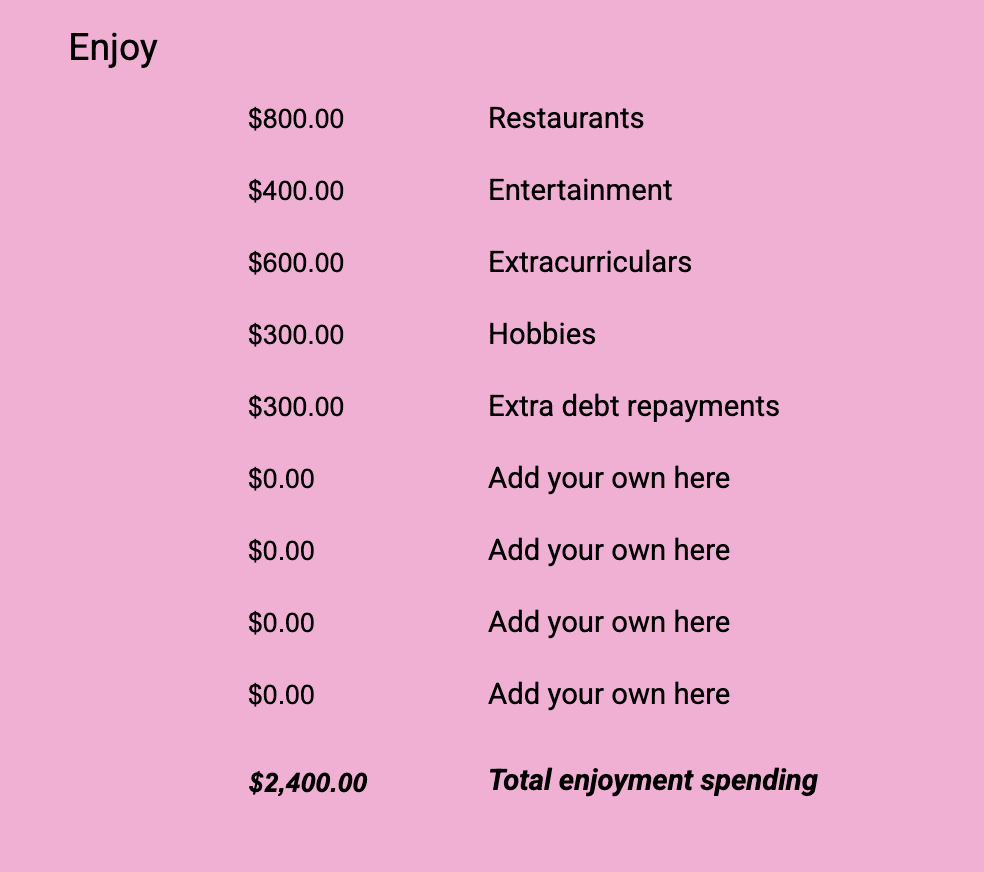
When you don’t plan any fun spending, you could end up feeling too deprived. That puts you at risk for blowing the budget, feeling guilty, and giving up altogether.
By giving every dollar a job, you can plan for fun—guilt-free.
Step 5: Review and Adjust Regularly
Budgets aren’t written in stone. They are living, dynamic plans. When you’re able to tweak and adapt the plan as needed, it’s not a weakness, but an advanced skill.
One month might bring a car repair. The next might include a birthday gift or a spontaneous trip. That’s normal!
The key is adjusting as you go. Throughout the month, you might reduce the amount designated toward one category in order to increase another. Each month, reassign jobs based on your priorities and circumstances.
Some months you’ll be in crisis mode, covering essentials only. Other months you’ll be in maintenance mode, funding goals more aggressively.
Flexibility keeps the system sustainable. Just make sure your plan ultimately matches your behavior, and that you’re working with your true income, no more and no less.
A Real-Life Example
I worked with a couple who had spent 25 years happily married without any sort of budgeting system.
Budgeting sounded awful to them—tedious, confusing, pointless. After all, they knew they had plenty of money and weren’t spending excessively.
But they constantly questioned their spending decisions—each other’s and their own.
“Why did we get another Amazon package?”
“We shouldn’t go out to eat. Let’s just eat leftovers.”
“I probably shouldn’t be buying this, but I’m doing it anyway.”
“Look how much you spent on that!”
“Why do we need one of those? What's wrong with the one we already have?”
What a tragedy to waste so much time worrying and resisting one another—especially if there isn’t a numbers problem.


They pushed past their fears to give a budgeting system a try. They worked as a team to plot out their first month’s spending plan, giving every dollar a job.
There was dialogue and disagreement during the process, but they ultimately created a plan they both liked. Plus, debate during the planning process was respectful and productive, unlike the kind of interaction that normally happened when they questioned each other’s spending after-the-fact.
To their surprise, having a plan immediately felt better than not. Their urge to criticize each other’s spending started to fade.
There were times early on when they reverted back to the complaining, as if by muscle-memory. The nit-picking habit becomes like a familiar song and dance between partners.
But they were able to stop and remind themselves that they had graduated from nit-picking. They could just laugh at themselves and drop it. With a plan, they never needed to bicker about money again.
You can unleash this same power in your life. Start with the mantra: "I give every dollar a job."
Common Mistakes to Avoid
If you’re new to a system, watch out for these pitfalls:
Forgetting irregular expenses. Don’t let annual bills or holiday shopping surprise you. Spread irregular spending amounts across the year as much as possible.
Being too rigid. Life happens. Budgets should adapt. It’s not a bad thing; it’s a sign of a healthy budgeting system.
Not keeping up with it. Giving every dollar a job isn’t a one-time event. Make sure your plan ultimately matches reality. Check in regularly.
The goal isn’t perfection—it’s progress.
The Bottom Line
Money doesn’t manage itself. If you don’t assign its purpose, it will slip away.
By giving every dollar a job, you move from chaos to clarity, from guilt to freedom, and from frustration to confidence.
It’s a simple mantra—but it can transform your financial life: “I give every dollar a job.”
